World / We / I
Three blind-drawn cards give you a quick snapshot: how the world looks, how "we" feel, and where you are in it right now.
The technique below lives inside Self-Work Navigator on our platform – open it and the steps walk you through automatically.
Open Self-Work NavigatorAbout this technique
World / We / I is a 10-minute self-reflection technique with metaphorical associative cards (MAC). Three blind-drawn cards give you a quick snapshot: how the world looks, how "we" feel, and where you are in it right now. The session is designed to be run on your own, in your browser, without a therapist or a registration step.
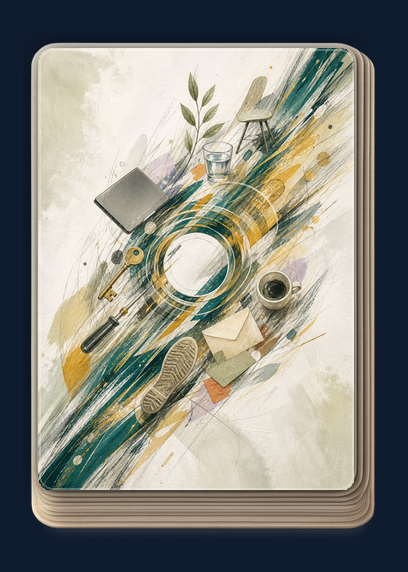
It fits when you want a quick read of your mood today. On the platform the steps walk you through automatically inside Self-Work Navigator, so you don't have to remember anything beyond the question you brought. We recommend starting with Urban Myth – it lands well for this kind of work.
Questions this technique helps with
These are the kinds of questions people bring to this technique. If you recognise yours, you are in the right place.
- Three card spread for life context. Three cards in a row: world today – we (your circle) – I in it. A short snapshot.
- Current life snapshot exercise. Useful when stuck or losing your bearings – three cards bring perspective back.
- Self-reflection on self and context. The spread pulls the hidden connection between outer world and inner state.
- How to find my position in life now. “World” and “we” cards create a frame in which it is easier to answer “where am I?”
- Midlife reflection technique with cards. Especially helpful in moments when the usual answers stopped fitting.
When this technique fits
- You want a quick read of your mood today.
- The day feels like one big lump – and this technique unbundles it into layers.
- It's useful as a weekly mini-journal.
When it doesn't fit
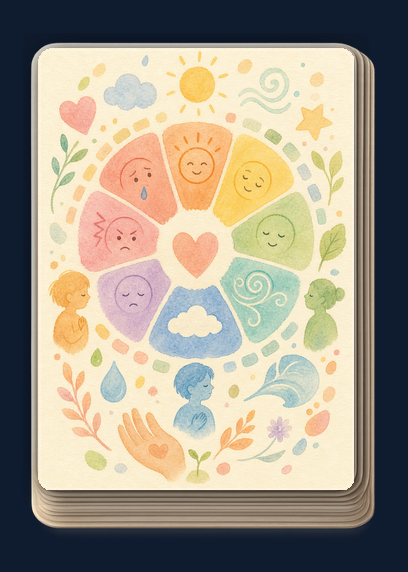
- If you're tired of analyzing and just want to rest – try "Safe Place" instead.
What you need
- 10 minutes of quiet.
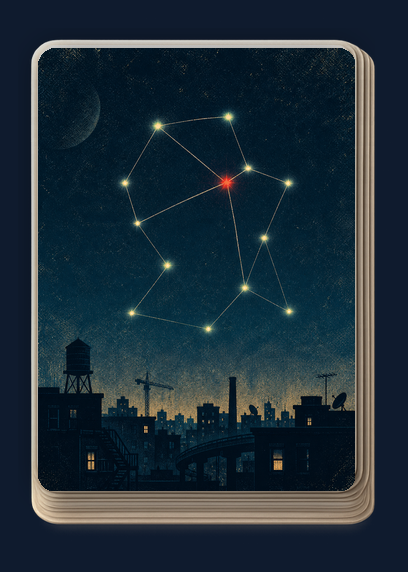
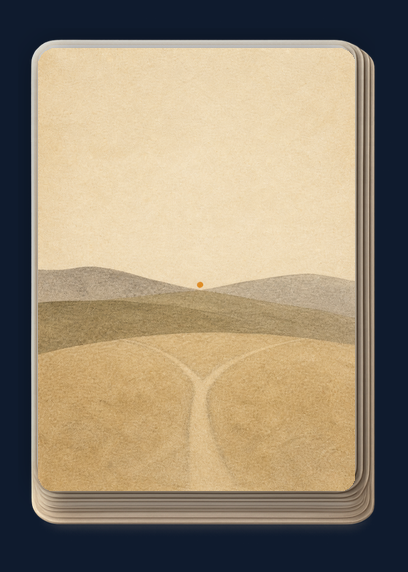
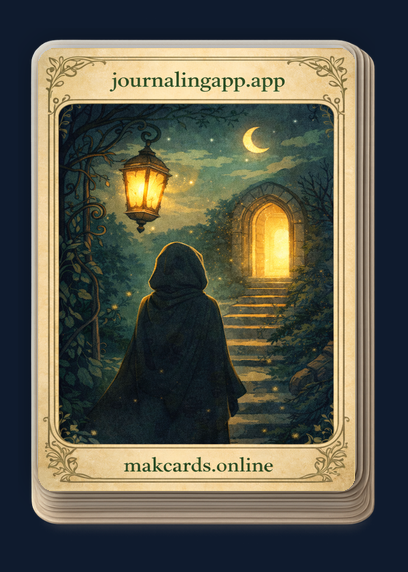
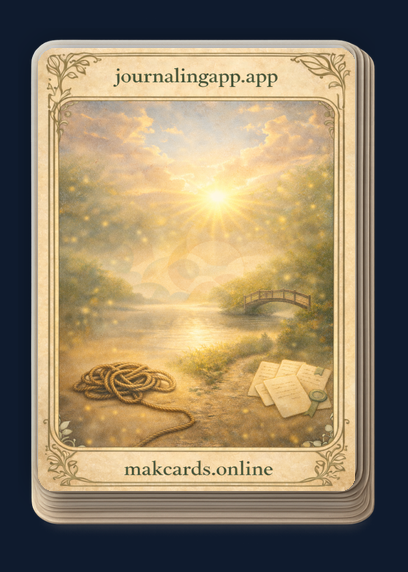
- Any deck with varied imagery. Story-style decks (The Open Door, Urban Myth) work especially well, but any deck will do.
The layout
3 positions. Each one has its own question, and the card in it answers that question rather than the whole request.
- 1WorldWhat does the world look like today?
- 2WeWhat state are we all in right now?
- 3IWho am I inside that?
How the session goes
-
1
Settle in
Sit comfortably. Take 2–3 calm breaths in and out. Tell yourself: "I'm going to look at my day in three frames. No right answers."
In this technique you'll draw three cards – one at a time – and work with each as you go. All three are laid out left to right: first about the world, second about "we", third about you.
-
2
First card: "The world today is…"
Draw a card blind – don't choose by eye, let it come. Place it on the left as the first of three.
Look at the image silently for 20 seconds. "World" here means what's around you today in the broad sense: the country, the news, the weather, the general background of life.
Then finish the sentence with a few words. Don't search for the "right" phrasing – take the one that comes first.
"The world today is…"
-
3
Second card: "We are now…"
Draw the second card blind and place it next to the first. "We" means people in your close circle, at work, in your city. Pick the "we" that matters more today.
If the first card pulls your attention and gets in the way – you can flip it face-down for now and turn it back over at the final review step.
Look at the second card and finish the sentence:
"We are now…"
-
4
Third card: "I am right now…"
Draw the third card blind and place it next to the second. The most important card. Don't rush.
Look at the image. Finish the sentence – one or two phrases about yourself:
"I am right now…"
-
5
Look at the three cards together
If you flipped any card face-down along the way, turn it back. Place your gaze on the whole row and ask:
Write down one observation that will be useful today.
- What do I notice first – are the three similar, or do they contrast?
- Between which two cards is there the most tension?
- Which of the three do I want to come back to during the day?
Closing the session
Take a deep breath in and a slow breath out. You can thank the cards and close them. If you'd like – keep the one image that resonated most in front of you for another minute.
If a lot came up
If the third card (about you) hit harder than expected, that's a sign something alive is inside. Write a couple of sentences in a notebook and come back to them in a few days. If it feels too heavy – talking with a therapist will help more than continuing alone.
Recommended decks
About metaphorical associative cards (MAC)
Metaphorical associative cards (MAC) are a projective tool used in self-reflection, coaching and therapy. Unlike tarot or oracle cards, they don't predict anything – the image becomes a mirror for what is already happening inside you, helping you put words on something that was unclear or hard to say directly.
You can work with MAC cards alone, with a therapist, or in a group. The card itself is not the answer; it is a frame for asking yourself a more honest question. The same image can mean very different things to two different people on the same day, and that is exactly what makes the tool work.