Safe Place
An anchor of calm in a single card: build an inner refuge you can return to.
The technique below lives inside Self-Work Navigator on our platform – open it and the steps walk you through automatically.
Open Self-Work NavigatorAbout this technique
Safe Place is a 10-minute self-reflection technique with metaphorical associative cards (MAC). An anchor of calm in a single card: build an inner refuge you can return to. The session is designed to be run on your own, in your browser, without a therapist or a registration step.
It fits when you feel anxious or noisy inside and want some ground. On the platform the steps walk you through automatically inside Self-Work Navigator, so you don't have to remember anything beyond the question you brought. We recommend starting with Light Within – it lands well for this kind of work.
Questions this technique helps with
These are the kinds of questions people bring to this technique. If you recognise yours, you are in the right place.
- How to calm down when anxious quickly. The Safe Place technique builds an inner anchor of calm via one card. Use it for everyday anxiety without dissociation.
- What to do during a panic attack alone. Simple body actions first (water, air, walk), then anchor through a card. If panic recurs, see a professional.
- Grounding technique for self-regulation. A MAC card becomes a visual anchor you can return to in hard moments – at work, before sleep, on the road.
- 5-minute relaxation technique. One image, one body gesture, one written sentence. That is your anchor.
- Safe place visualization in the browser. Open the platform, draw one card blind from Light Within deck – Self-Work Navigator walks you through.
- Resource MAC card for grounding. Warm landscapes and states from Light Within deck work as resource anchors you naturally return to.
- Highly sensitive person calming exercise. Regular anchor practice builds a return-spot to calm before sensory overload hits.
When this technique fits
- You feel anxious or noisy inside and want some ground.
- First time meeting these cards: a gentle entry without going deep.
- You want to build a "return spot" you can use in hard moments later.
When it doesn't fit
- If strong feelings are overwhelming you right now and you don't feel in control of them – step away from the cards first. Do something simple with your body (drink water, splash your face, walk a few minutes), and come back to this technique later.
What you need
- A quiet spot, 10 minutes without interruptions.
- A comfortable position. You can close your eyes between steps.
- Optional: paper and pen to write a one-line note at the end.
How the session goes
-
1
Recall a place where you feel safe
It can be a real place (your childhood room, a forest near your dacha, a corner of your kitchen) or imaginary (a shore, a cabin in the mountains, anything). Don't pick the "right" place – pick the one that feels warmest right now.
If several places come to mind, settle on one – the warmest of them.
-
2
Draw a card blind
Don't choose by eye. Just let the system pull the card that "comes" – it will become the image of your safe place.
If the first card doesn't resonate at all, you can pull one more. Don't pull a third – choose the closer of the two.
-
3
Describe the place through the five senses
Look at the card silently for 30–40 seconds. Then, mentally or out loud, answer:
You don't need a full answer – one word per sense is enough.
- What do I see in this place?
- What do I hear – sounds, silence, voices?
- What do I feel on my skin – temperature, wind, texture?
- What does it smell like here?
- What's the taste in my mouth, if any?
-
4
Find a body anchor
Pick a simple gesture that connects you to this place. For example: a hand on your chest, fingers crossed, a slow inhale on a count of 4 and exhale on 6. One small thing you can repeat without anyone noticing.
Do the gesture right now and hold your attention on the body sensation for about 20 seconds.
-
5
Practice the return
Move your attention away: look out the window, wiggle your toes. Then bring it back to the card and do your gesture again. Notice how the sensation shifts.
Repeat 2–3 times. That's the training: how to come back.
-
6
Write down a single phrase
One sentence for your future self. For example: "My place is by the water; my gesture is a hand on my chest." This is the anchor you can return to a day or a week from now.
Closing the session
Take three slow breaths in and out. Notice how your feet sit on the floor, how your body sits on the chair. Look around and silently name three things you see right now.
You can keep the card open on the table for another minute, until you feel ready to close it.
If a lot came up
Sometimes even a calm technique stirs something deeper – that's normal. Give yourself a few minutes of plain things: tea, fresh air, a chat with someone close. If something heavy stays inside and won't let go, talking with a therapist will help more than working alone.
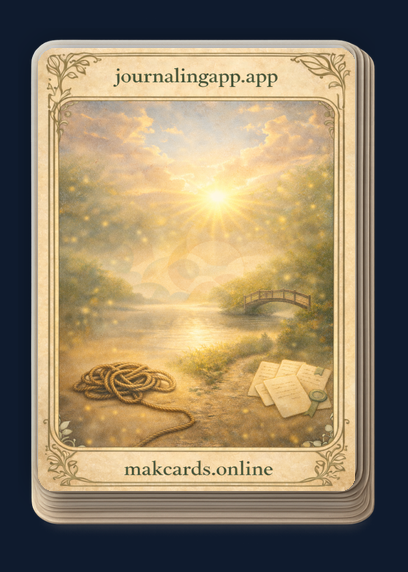
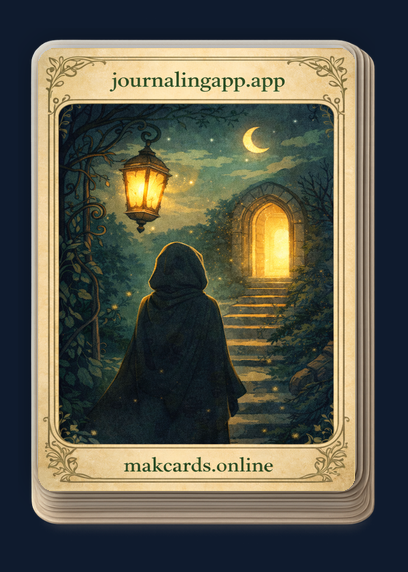
Recommended decks
About metaphorical associative cards (MAC)
Metaphorical associative cards (MAC) are a projective tool used in self-reflection, coaching and therapy. Unlike tarot or oracle cards, they don't predict anything – the image becomes a mirror for what is already happening inside you, helping you put words on something that was unclear or hard to say directly.
You can work with MAC cards alone, with a therapist, or in a group. The card itself is not the answer; it is a frame for asking yourself a more honest question. The same image can mean very different things to two different people on the same day, and that is exactly what makes the tool work.