Picture and Word
One card plus one word – a simple way to hear in yourself what's hard to say directly.
The technique below lives inside Self-Work Navigator on our platform – open it and the steps walk you through automatically.
Open Self-Work NavigatorAbout this technique
Picture and Word is a 10-minute self-reflection technique with metaphorical associative cards (MAC). One card plus one word – a simple way to hear in yourself what's hard to say directly. The session is designed to be run on your own, in your browser, without a therapist or a registration step.
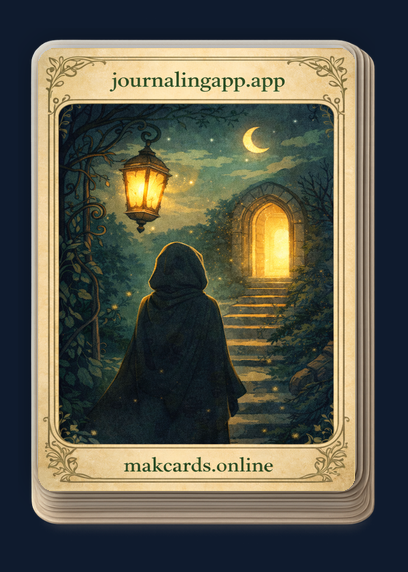
It fits when a lot is going on inside, and words don't quite catch it. On the platform the steps walk you through automatically inside Self-Work Navigator, so you don't have to remember anything beyond the question you brought. We recommend starting with The Open Door – it lands well for this kind of work.
Questions this technique helps with
These are the kinds of questions people bring to this technique. If you recognise yours, you are in the right place.
- How to name what I feel right now. An image card plus a word card helps pull out the nuance of an emotion you have no words for yet.
- Picture and word combination MAC. One image plus one word often sounds more precise than a long description.
- MAC technique image and word. Good for journaling – try two or three pairs and keep the one that resonates.
- How to describe my state in one word. A word next to a card gives a point of support. Useful in burnout and unclear anxiety.
- Word card self-reflection practice. Helps break through “everything is fine” to a more precise state.
When this technique fits
- A lot is going on inside, and words don't quite catch it.
- You want to practice listening to associations without judging "right or wrong".
- A light technique for getting acquainted with the cards.
When it doesn't fit
- If you want a concrete plan of action – this isn't about action, it's about clarifying meaning. Try GROW or the Five Steps instead.
What you need
- 10 minutes of quiet.
- Any deck of your choice. Decks with rich detail and context work a bit better, but it's not required.
How the session goes
-
1
Think of a situation you want to look at
Not necessarily a "problem" – it can be a relationship, a period of life, an important person, a work task. Phrase it for yourself in one line: "I want to look at ___."
-
2
Draw one card blind
Don't choose by eye. Just let the card come.
-
3
Silent looking
For 30–40 seconds, just look at the card. Don't try to "decode" it. Notice:
- Where does your gaze settle – which fragment?
- What's the mood of the image?
- What's "loud" in it, and what's "quiet"?
-
4
Catch one word
Two paths, depending on how you set up the table:
If you've added the Words group – draw one word card blind. That word is yours.
If you're working without the Words group – close your eyes or look away for a second. Ask yourself: "What one word comes to this image?" Not two, not a phrase – one word.
It can be a noun (silence, road, mother), an adjective (heavy, bright), a verb (waiting, letting go) – anything. Take the first one that comes, even if it feels strange or unclear.
-
5
Connect image and word
If you drew the word as a card (Way A), you can physically combine them: drag the word card onto the image card (or vice versa) – they merge into one, and the word shows over the image, just like a classic OH card. It's a handy way to keep the pair in one place for your eye.
If you're working without a word card – just look at the image while holding your word in mind.
Notice how the image and the word start to "sound" together. Then ask yourself:
- What does this pair (picture + word) say about my situation?
- If this word were a hint, what is it hinting at?
- What hadn't I noticed in this theme before?
-
6
Write down the formula
In one sentence: "My situation right now is [the image of the card] and [the word]." For example: "My work right now is a long corridor and the word 'wait'."
This phrase is a concentrate. It's easy to come back to later.
Closing the session
A calm breath in and out. Close the card. If you'd like – repeat the formula phrase silently to yourself once more, and let it stay in memory for the day.
If a lot came up
Sometimes one word opens what's been long sitting "at the edge". If it rose up stronger than expected – a few minutes with a warm drink or a short walk often closes the work well. If the heaviness stays inside, talking with a therapist will help more than digging on your own.
Recommended decks
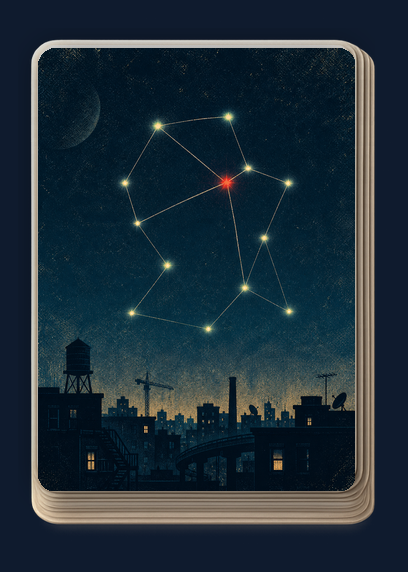
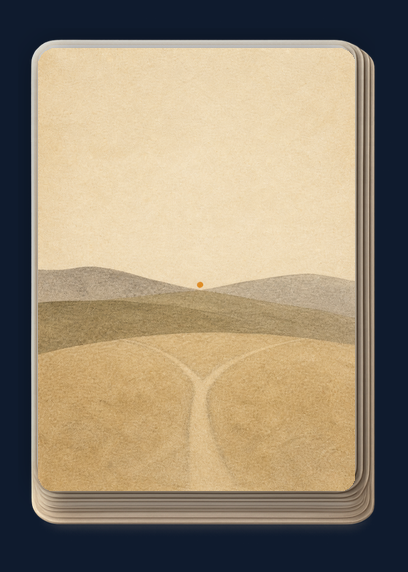
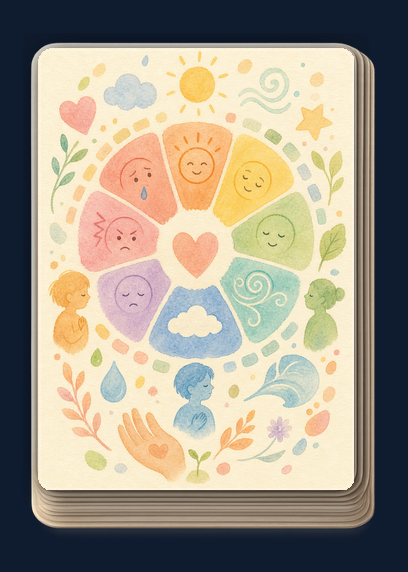
About metaphorical associative cards (MAC)
Metaphorical associative cards (MAC) are a projective tool used in self-reflection, coaching and therapy. Unlike tarot or oracle cards, they don't predict anything – the image becomes a mirror for what is already happening inside you, helping you put words on something that was unclear or hard to say directly.
You can work with MAC cards alone, with a therapist, or in a group. The card itself is not the answer; it is a frame for asking yourself a more honest question. The same image can mean very different things to two different people on the same day, and that is exactly what makes the tool work.