Timeline: Yesterday / Today / Tomorrow
Three cards in a row – where I came from, where I am now, where I'm headed. A simple way to see movement.
The technique below lives inside Self-Work Navigator on our platform – open it and the steps walk you through automatically.
Open Self-Work NavigatorAbout this technique
Timeline: Yesterday / Today / Tomorrow is a 10-minute self-reflection technique with metaphorical associative cards (MAC). Three cards in a row – where I came from, where I am now, where I'm headed. A simple way to see movement. The session is designed to be run on your own, in your browser, without a therapist or a registration step.
It fits when it feels like you're "stuck in place" – this technique helps you see the movement that's actually there. On the platform the steps walk you through automatically inside Self-Work Navigator, so you don't have to remember anything beyond the question you brought. We recommend starting with Urban Myth – it lands well for this kind of work.
Questions this technique helps with
These are the kinds of questions people bring to this technique. If you recognise yours, you are in the right place.
- Where am I going in life now. Three cards: yesterday – today – tomorrow. A simple way to see if there is movement and in which direction.
- Yesterday today tomorrow card spread. The spread works like a mirror: shows how one flows into another, and where you are inside the movement.
- Seeing direction in life exercise. Useful when everything feels stuck or, conversely, chaotic – cards bring back the sense of a path.
- Past present future MAC cards. Working with time as space. Especially valuable in moments of transition and crisis.
- Yesterday-self today-self tomorrow-self. Three states of self by card. Helps notice what changes in you, not just around you.
When this technique fits
- It feels like you're "stuck in place" – this technique helps you see the movement that's actually there.
- Before the start of a new chapter: the first day of the week, the start of a project, after a move.
- When you want to feel which direction you're pulled toward.
When it doesn't fit
- If "yesterday" is a specific traumatic event that still hurts – better to start with "Safe Place" first, and come back to the timeline later.
What you need
- 10 minutes of quiet.
- Any deck. Story-style decks give a bit more sense of motion, but it's not required.
The layout
3 positions. Each one has its own question, and the card in it answers that question rather than the whole request.
- 1YesterdayWhere did I come into this from?
- 2TodayWhere am I in it now?
- 3TomorrowWhere is it moving?
How the session goes
-
1
Choose the theme of your line
The timeline doesn't work in general – it works on a specific theme. Phrase what you want to trace:
- "My state at work"
- "My relationship with myself"
- "Project X"
- "Me as a parent"If no theme stands out, take "me overall". That's enough.
In this technique you'll draw three cards – one at a time – and work with each as you go. All three are laid out left to right: "Yesterday", "Today", "Tomorrow". "Yesterday" and "tomorrow" here aren't calendar days; they're shorthand for the recent past and the foreseeable future.
-
2
First card – "Yesterday"
Draw a card blind – don't choose by eye, let it come. Place it on the left.
Look at the image silently. Then answer:
You don't need to "remember exactly" – the card isn't about chronology, it's about mood.
- What is the main thing I see here?
- What feeling does it bring up?
- What in my recent past does it resemble?
-
3
Second card – "Today"
Draw the second card blind and place it in the middle.
If the first card gets in the way of focusing, you can flip it face-down for now and turn it back over at the final review step.
- What's the main thing I see?
- What in this card resonates with how I am now?
- What is there most of – action, expectation, silence?
-
4
Third card – "Tomorrow"
Draw the third card blind and place it on the right.
- What's the main thing I see?
- Does this card draw me in or unsettle me?
- What can I take from it already now?
-
5
Look at the row as a whole
If you flipped any cards face-down along the way, turn them back. Place your gaze on all three cards together and notice:
- Where is there the most movement – between which cards?
- Is there a common thread through all three?
- What changes and what stays?
-
6
Write down one phrase about movement
For example: "I'm leaving ___ through ___ toward ___." Or: "The main movement is from heavy responsibility to a lighter rhythm."
This is your anchor. It's good to come back to in a week.
Closing the session
Take a slow breath in and out. Gather the cards in reverse order: first "tomorrow", then "today", then "yesterday". A small gesture – we come back to the present.
If a lot came up
If the "yesterday" card brought up something painful, don't linger on it – this technique isn't designed to go deep into the past. Note your observation and let it be. If a lot came up and won't let go, talking with a therapist will help more than continuing alone.
Recommended decks
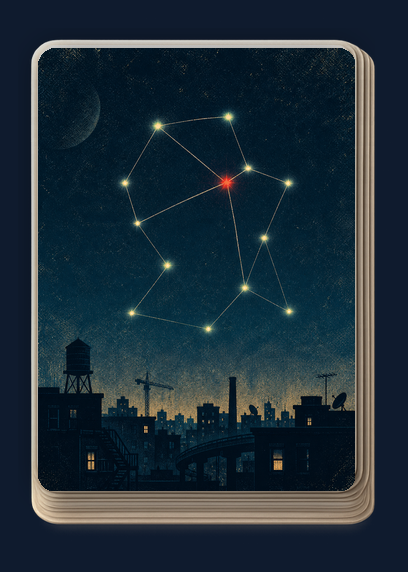
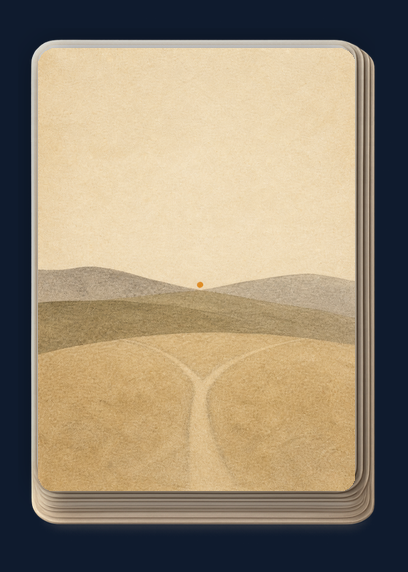
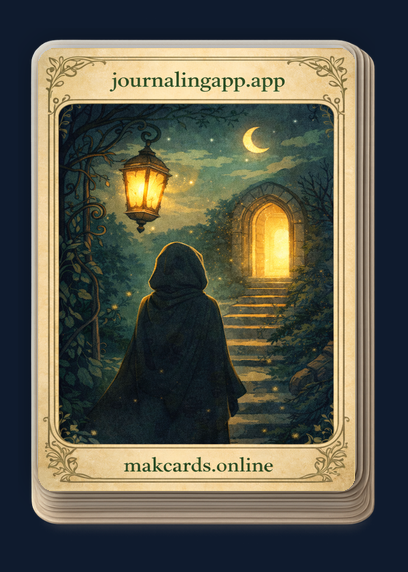
About metaphorical associative cards (MAC)
Metaphorical associative cards (MAC) are a projective tool used in self-reflection, coaching and therapy. Unlike tarot or oracle cards, they don't predict anything – the image becomes a mirror for what is already happening inside you, helping you put words on something that was unclear or hard to say directly.
You can work with MAC cards alone, with a therapist, or in a group. The card itself is not the answer; it is a frame for asking yourself a more honest question. The same image can mean very different things to two different people on the same day, and that is exactly what makes the tool work.